
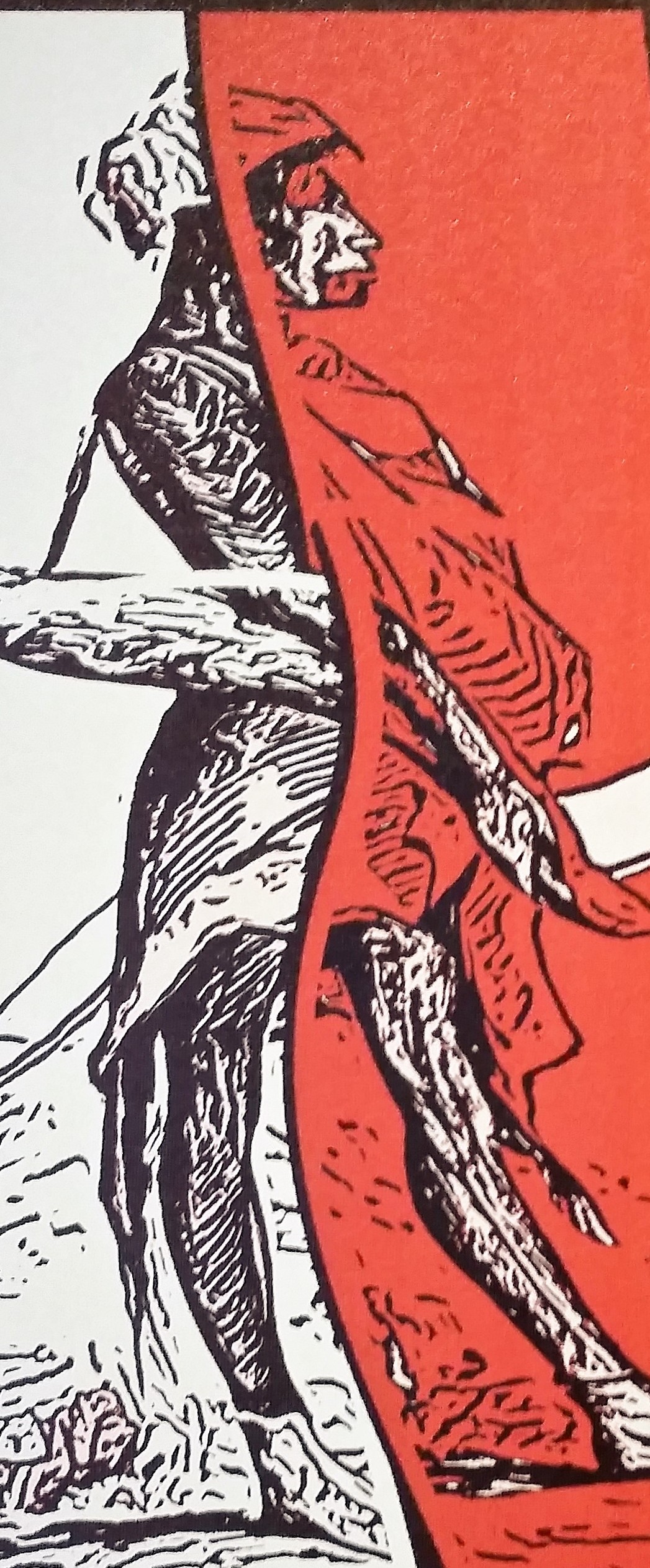
Over the past five centuries every manner of negative action was taken against Indigenous peoples. Murder, genocide, holocaust, slavery, indentured servitude, theft, extortion, kidnapping, deliberately introducing diseases, wiping out the food sources of the people, total war, razing of cities and civilizations, and the list goes on. Then once everything was taken and under the control of the “civilized” peoples, they even took away history and identity. Assimilation and termination of tribal societies caused erasure of histories and people’s past identity. Its been a tough five centuries for indigenous peoples.
In Oregon, genocide and dispossession of land was the rule, tribes were removed to reservations to both save them from the attacking Americans, and to get them out of the most prized lands that the settlers wanted. In the 1850s nearly daily schooner loads of miners arrived in the area ports. During this time the US regular army were actually the good guys, with General John E. Wool working to save the Indians from marauding whites. These miners went into the country to seek their golden fortunes and would attack any tribes that stood in their way. and when gold was not found then they could make depredation claims to the territorial governments to recoup their losses of supplies and ammunition from killing Indians. Death came easy to native people in those days. There were no laws in the land, the army could not cover the whole territory to impose the peace, and would not hold Americans accountable for their actions.
This was the American West, a world of Cowboys and Indians, where daily, weekly and monthly conflicts between greedy fortune seekers and the tribes caused a nearly constant series of battles. This era lasted until at least 1900 (and probably beyond), with a series of “Indian” wars, in all cases the wars were caused by the desires of the Americans to take what the Indians had, land and resources.
But did the war end the the 20th century? Many look to the fishing and water conflicts and say no, Indian peoples are still fighting the war for their land, resources and life-ways from Americans that wanted to put dams into prime fishing areas, to extract minerals from the land, to run pipelines across our lands, to dump uranium on our land, to log our forests, and to take our lands for cattle grazing. All manner of ways that Indian lands continued to be coveted by the Americans, and then there came to be new inventive appropriations as well.
Our identities. Not only are we not allowed to be Indians, and the federal government worked hard to eliminate our identities through boarding schools, but now we have to fend off waves of appropriators. People who choose to take aspects of Native identity and culture and use it as if its their own. From mascots to cultural appropriators, we are now constantly calling foul on people who abuse and try to steal our cultures and identities. Its racism, its white privilege, its the ultimate invasion of who we are as people.
I recently was asked to address an issue of cultural appropriation in Eugene, Oregon. This is tough issue for me as this is right in my backyard, in a place I lived for least twelve years and also within the traditional territory of my tribe. As a Kalapuya descendant, of the Santiam and Yoncalla Kalapuya tribes, this issue is occurring right where I exist as a cultural person. Knowing that many people have no idea what it means to identify with a place, I drafted this history to provide context and meaning from my personal perspective. I have made minor edits from the original.
Cultural Appropriate and the Continued Invisibility of Kalapuya Culture in Eugene-Springfield
Eugene-Springfield is a special place. A second home to many alumni (including myself) who have attended the University of Oregon. A place where the 1960s-70s hippie culture survives and thrives. The second largest city in Oregon and a thriving economic center. A place of valley prairies, of riverine environments, mountainous vistas, camas prairies and a gateway to the Pacific coast. It is also a Native home land; the long term (10,000+ years) traditional homelands of the Chifin (Chafan) Kalapuya peoples.
The Native history of this place was obscured for over 100 years with the development of Eugene-Springfield, the 1856 removal of tribes to the Grand Ronde Indian Reservation, and their eventual termination in 1954. Yet their ancestry survives in the present members of the Grand Ronde tribe, politically restored in 1983 and thriving on the former reservation site. In the past 20 years the tribe has reached out to Eugene and made a few investments, a short-lived satellite office, a Chinuk wawa language program at LCC, and culture classes which continue at the Chifin Native Center in Springfield. In addition, the recently completed I-5 bridge replacement project, Whilamut Passage, benefited from a series of Kalapuya culture-themed projects on the upper deck of the highway and in the commuter corridors under the bridges. Perhaps the biggest Native center in the town is the Many Nations Longhouse, completed in 2005, that was supported by all regional tribes and hosts weekly Native events. In short, despite over 130 years of degradation of Native presence in Eugene-Springfield, and seeming invisibility of Native peoples, the area is rich with Native restorative activity, many people working to bring back and honor the original Native culture which has existed for so long on this land.
Personally, I have been heavily involved with this work for over 20 years, on many levels accessing my Kalapuya-Chinook-Takelma ancestry. I attended the University of Oregon and completed three degrees. I worked with many Native and non-native people of the local community to honor native traditions. I participated in planning several UO Pow wows, was a co-director of NASU, served on the board of Celebrating Traditions, aided and advised efforts to build community longhouses for some of the area parks, and served on the UO Longhouse building board. In 2006, when I became Cultural Manager for the Grand Ronde tribe I continued to work on area projects, including advisory to ODOT, along with Siletz elder Esther Stutzman, for the artistic enhancements projects of the Whilamut Passage bridges for 9 years. In 2014, I helped name the Chifin Native Center with a place name of the original Kalapuya tribe, provided a history exhibit for them, and now I continue to conduct presentations about local Native history and culture at university and at public events in the area.
With all this work of developing back, returning and revitalizing, the original Native presence in Eugene, it is head scratching to hear about continued cultural appropriation of Native culture occurring in Eugene.
The issue of cultural appropriation is endemic in Eugene. There are folks around town who have engaged for years in offering training in “native survival” arts and in having “sweats” in a nativist tradition. Other folks have attempted to borrow Native artists’ traditions or even rename themselves with native sounding names when they have no cultural relation to Native peoples. A good portion of the population of this city is interested in and attracted by Native traditions, romantically, spiritually, and culturally, and many seek to emulate the culture. To parallel the pattern, I recently learned that a group connected with the Oregon Country Fair Board is engaging in carving what they termed a “Haida totem pole”. Yet, the product they are creating is not a Haida totem pole, not even remotely Native in the manner in which its being planned and constructed. Individuals connected with the board have asked the Haida Tribe in British Columbia if there has ever been an attempt to contact them about this project, and they have answered negatively. The carvers have suggested that the project has been blessed by a local Native American individual, yet no individual has the right to bless any such product based on the cultural traditions of another tribe (or even use another tribe’s name in artistic projects).
To Native peoples, the situation is part of the phenomenon of white privilege to assume anyone can use any tribal name, and define any tribal culture in any way without any responsibility to request approval from the original Tribe. The pole does not have the depth of spiritual meaning, represent the work of the Haida people, or have the benefit of Haida cultural techniques. Tribes do not grant rights to use their designs to just anyone. Native master carvers work for years to master their craft and they earn the rights to carve the designs of their ancestors. There has been no apparent attempt to gain such rights by the Country Fair group and in fact, the pole, as represented on their Internet images, does not appear to look like a Haida pole, it does not exhibit the mastery of the traditional art form.
As an anthropologist, I know well the history of cultural appropriation. For over 100 years, collectors engaged in the theft of native culture to fill museums and collections around the world. Then anthropologists took it upon themselves to become the experts in their subject cultures by publishing books and publicly becoming the go-to experts about the culture of tribes. This severely disempowered tribes to represent themselves and tribes have pushed back against this phenomenon for the past 40 or more years. Tribes now assert their sovereign rights to define themselves, and take offense when their name is connected to a project they did not approve of or have any involvement with.
Cultural appropriation is what the “Haida” Totem pole represents to Native peoples. Even the use of the words “Haida” and “Native” and “Totem” suggest that the project has Native roots. Yet without any consultation with a Tribe or consultation with Native peoples, using the words mentioned is really an attempt to establish a level of legitimacy with the public. Native-themed, this is the sort of project that the folks of Eugene-Springfield would be interested in; then as the majority of the community are relatively uninformed about Native history and culture, they may assume that this is a project of Native origin. For the community’s edification, the carving inaccurately represents the Haida tradition, and should it be installed will falsely educate people about what “Haida” carvings look like, and/or that it is truly “Native” at all.
There are other ways to approach this sort of project. An attempt to reach out to the Haida Nation may benefit the Country Fair if they really desire a true Native Totem Pole. But back to my original point, Haida traditions, should they be sought out in the proper way, do not represent the true Native culture in this region of western Oregon. There are many Kalapuya people that live in this region, (as well as neighboring tribal artisans that would be perfectly acceptable) carvers and artisans who are part of the community and can serve as artists and advisers for such projects. Kalapuya people have their own artistic and intellectual traditions and are currently engaged in any number of projects in the region. The Kalapuya culture did not have totem poles, but instead Power Poles with deep meanings within the local communities that existed here for over 10,000 years, and still live here.
It seems very odd with all of the work that has occurred in the Eugene area to bring accurate Kalapuya representations to the community that the Oregon Country Fair Committee did not, and has not yet embraced the notion of reaching out to the Kalapuya people or the local tribes to request a traditional product. Minutes from the last meeting of the board (February 1, 2016) are now referring to the project as a “Story Pole” and they suggest they may be moving toward Tribal consultation, but there is also an inexplicable resistance.
In the past two decades there have been numerous projects, the permanent Native exhibits at the Museum of Natural and Cultural History, the plank house at Dorris Ranch, the Many Nations Longhouse, the various artistic products along the Whilamut Crossing bridge project, and the Kalapuya Stones of the Whilamut Natural Area of Alton Baker Park. All of these projects have involved Kalapuya people who were working to faithfully represent Kalapuya culture, traditions and history for the Eugene Community. As Kalapuya people we have a deep caring for this land because we have lived here for so long and created the wealth of the valley.
The debate about this particular project continues at the Country Fair Board meetings. I urge the community to speak to the board about their preferences regarding such public projects, and urge the board to reconsider the direction of their project.
Cultural appropriation is not the way to live in a respectful community. Native peoples were disempowered, colonized, and removed from this land to make way for white Americans, and so have suffered enough abuses. To live in a respectful plural community is a great desire for all people even Natives. It makes no sense to continue to take advantage of Native people by taking aspects of our identity and using and abusing us in this manner. Many people in the community are not happy with the direction or tone of this project.
I have made an attempt to communicate with the Haida Tribe of Alaska, and they have yet to respond. It is my understanding that the local tribes have partly responded to a letter of inquiry from the Board. The letter above has been presented (in part) to the board. My letter was originally to be published in a local paper but they apparently do not want to touch the issue. Updates will be provided as possible.
The Follow-up article, 3/23/2016, An Argument for Decolonization.


Leave a Reply
You must be logged in to post a comment.